Monday, November 27, 2017

R Ashwin - Ashwin bags 300-Spinning the wheel of fortune for Team India

Contact Us
//tealium ends
R ASH
      Ravichandran Ashwin, India's new spin-spearhead, is now the fastest cricketer in the history of Test cricket to have taken 75 wickets and amassed more than 500 runs. His heroics at Chepauk in the first Test (February 22 - 26, 2013) against Australia earned India a thumping win, also with it, his match figures of 12 for 198 gave him another milestone of becoming the first Indian to take a 10-wicket haul on his home ground. 

Born on 17th September 1986, Ravichandran Ashwin had earlier captivated the Indian audiences with his bowling exploits in the shorter form of the game, but ever since his Test debut against West Indies in 2011, Ashwin has surprised one-and-all with his ability to pick up quality wickets and also sustain the pressure of filling in the boots of Harbhajan Singh, who has found it tough to get back into national colours. 

The fact that he makes valuable contributions down the the order makes him almost a certainty for every match and he already has two Test hundreds (both against West Indies) apart from a few fifties. His batting was flawless even in Australia, where the top-order could never really get going in the 2011-12 series. 

He made his debut for Tamil Nadu against Haryana in Chennai in the 2006-07 season. He has an impressive domestic record, having scalped 134 wickets in 34 appearances for Tamil Nadu. However, he has made a name for himself in the shorter formats of the game, more so in T20 cricket where his accuracy and shrewdness has made him a dependable bowler. 

A consistent season at the domestic level earned Ashwin a grade 'D' contract with the BCCI. He also led Tamil Nadu to victory in the domestic one-day trophy in 2009. When Harbhajan opted out of the first two games against South Africa at home in early 2010, Ashwin was called in as his replacement. He did not get his chance then, but impressive performances for the Chennai franchise in the subsequent edition of the IPL meant that he was always knocking on the door. His chance finally arrived in June 2010 when India rested several of its stars for the tri-nation series featuring hosts Zimbabwe and Sri Lanka. He ended up with figures of 2/50 on his debut against Sri Lanka in Harare. 

Ashwin was included in the Indian squad for the 2011 World Cup, but Dhoni played him in only two games and then surprisingly omitted him in favour of Sreesanth in the final. Ashwin has been consistent in the opportunities that he has got so far and has taken over as the lead spinner in the Test side after the selectors dropped Harbhajan for the Test series against West Indies in 2011. He formed a successful partnership with left-arm spinner Pragyan Ojha, especially in Tests in India. 

Having played for Chennai as a home based player and impressing the team management, Ashwin was bought back by his city franchise after a tough bidding war with the Royal Challengers of Bangalore for a whopping $800,000 in the 2011 IPL auctions. And quite understandably after his very impressive run for India, the BCCI offered him a Grade A contract. 

Ashwin was adjudged the Man of the Series in the Border-Gavaskar Trophy in 2013. He ended the Tests with an impressive tally of 29 wickets and became the third Indian off-spinner to take 25-plus wickets in a series after Harbhajan Singh (32) & EAS Prasanna (26). In the first Test match of the Tendulkar farewell series against West Indies in November 2013, Ashwin got his second Test ton and also put on a record seventh wicket partnership of 280 runs along with Rohit Sharma. In the second game in Mumbai, he became the fastest Indian to reach 100 Test wickets in just 18 matches. 

He was not preferred for Tests in overseas conditions and did not feature in the games in Durban, Auckland and Wellington, respectively. However, he continued to play the limited overs formats and went on to bag 100 wickets in ODIs during the 2014 Asia Cup. Ashwin's clever bowling strategies in the T20 format earned him an extended stint at Chennai as the franchise retained him for the 2014 edition. He also did well for India at the 2014 World T20, bagging 11 wickets in the tournament to top the bowling charts for his side. 

Ashwin played the last two Test matches of the England tour, before playing the ODI series. The selectors then decided to rest him for the home series against West Indies, before bringing him back for the Sri Lanka ODIs. He also played three Test matches in the 2014-15 Border Gavaskar Trophy. 

Ashwin's performance in the 2015 World Cup was greatly appreciated because of his disciplined and accurate bowling. He picked up 13 wickets in the tournament and also registered his best ODI bowling figures of 4/25 against United Arab Emirates. 

While Ashwin was slowly gaining in maturity, it was clear that his best was yet to come. During the tour of Sri Lanka, he mesmerized the hosts and ended with 21 wickets from the series - playing a big hand in India's 2-1 series win, their first in the island nation since 1993. He then followed it up with an excellent home season against South Africa, taking 31 wickets from four Tests. 

2016 turned out to be a watershed year in Ashwin's caeer. He not only earned wickets, but got them using the fine art of deception. His bowling improved vastly, the flight and the guile was back and he was an altogether different beast. West Indies, New Zealand and England found them out in succession. 72 was his haul from just 12 Tests - Ashwin had now turned into a complete all-rounder, handy with the bat and devastating with the ball, enough for him to secure the prestigious ICC Test player of the year award as well as the ICC Player of the year award - becoming only the second Indian after Rahul Dravid to scoop both the awards simultaneously. 
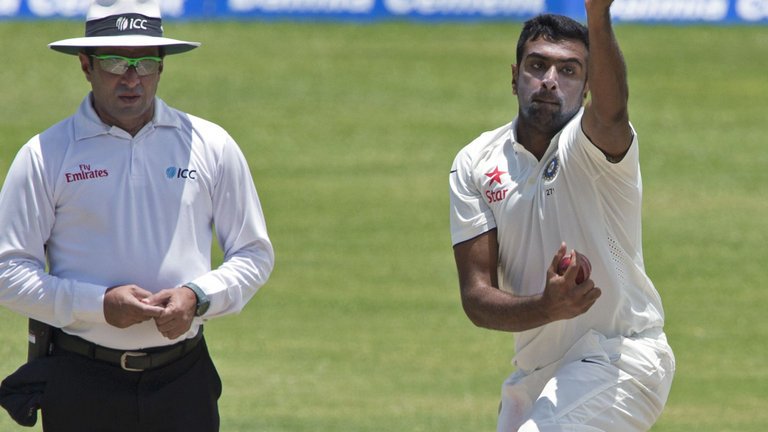


Year 2017 sustained Ashwin's good stretch, when he picked up a minimum of 50 wickets in a year for the third consecutive time. Ashwin, during the second Test against Sri Lanka at Nagpur, became the fastest bowler to 300 Test wickets. He got to the milestone in his 54th Test, leaving behind Dennis Lillee (56 Tests) and inspiring India's joint-highest Test win by an innings and 239 runs.

Refernce:

http://www.cricbuzz.com/profiles/1593/ravichandran-ashwin

https://i.ytimg.com/vi/_Zbu1gsYykM/maxresdefault.jpg

https://www.quirkybyte.com/wp-content/uploads/2016/03/ravichandran-ashwin1.jpg

https://cricshots.com/wp-content/uploads/2017/07/ravichandran-ashwin-west-indies-v-india-cricket_3750972.jpg

Contact Us

Friday, November 24, 2017

Murali Vijay - Bring Slow & Strong Style from the south of India


A tall, well-built lad, Murali Vijay was born on April Fools day 1984 in Chennai. He started playing cricket only at the age of 17 and immediately made headlines with his pleasing strokeplay. Playing for Tamil Nadu in domestic cricket, he forged a strong opening combination with another young talent, Abhinav Mukund. They both made headlines when they were involved in a 462-run partnership for the opening wicket in a Ranji Trophy game. Even though they fell short of the world record by just 2 runs, Murali Vijay's potential had not gone unnoticed and soon he was picked to make his Test debut against Australia in the fourth and final Test of the Border-Gavaskar Trophy, in Nagpur, in November 2008. He was selected for the match after Gautam Gambhir received a one-Test ban for elbowing Shane Watson in the third Test of the same series at the Feroz Shah Kotla in Delhi. 


Vijay had a solid Test debut Test scoring 33 and 40 and impressed one and all with his assured batting. Strong both of the back and front foot, Vijay is merciless when in the mood. Not afraid to dance down the wicket against the spinners, he is known to take the game by the scruff of the neck. He also has the ability to play the long innings - with the aforementioned 462-run partnership being an example. 

Vijay is a fine close fielder as well. He fielded brilliantly in the close cordon in his debut Test with his quicksilver reflexes accounting for Michael Hussey who was sensationally run-out while attempting a single. Earlier in the innings he had run-out Matthew Hayden as well with a direct-hit. It was a debut to remember for Vijay as India clinched the series 2-0. 

In and out of the side, Vijay's maiden hundred in the longest format came at Bangalore against the mighty Australians in October 2010. But in the next nine innings he failed to get a fifty and he was quickly out of the side. After a fruitful 2012-13 domestic season, he was back in the reckoning, this time at the expense of out-of-form Gautam Gambhir. He made a mark almost immediately, as he made 167 - his second century and his highest score in Test cricket. 

Vijay, for a long time, had been looked upon as a backup opener in Test cricket as the duo of Gambhir and Sehwag were going strong. The right-hander had to wait a while before finally making his ODI debut in 2010 against the visiting Proteas in Ahmedabad. But his 50-over career was not that convincing, with him failing to go past 50 on a single occasion. He failed to grab the backup opener's slot for the 2011 World Cup. 

Vijay was picked up by the Chennai Super Kings to play in the IPL and he played in a couple of games for them in season 2 without making much of an impression. But the 2010 edition was completely different, people were stunned to see the ease at which he plays the pick-up shot over mid-wicket and often deposits the ball way over the fence. Eventually, he ended the season as the second highest run-getter in his side, which also included a memorable 56-ball 127 against Rajasthan Royals, the highest individual score for any player in the entire season. Since then, Vijay has gone on to be a consistent performer for his franchise, especially in knock-out matches. He was the highest run-getter in the 2010 Champions League in South Africa, which CSK won. He was the Man of the Final in the 2011 edition as his 52-ball 95 helped CSK overcome RCB to clinch the title. He also scored his second IPL century when he smashed Delhi Daredevils out of the competition in the Qualifiers of IPL 2012. In the next edition, however, he lacked consistency and was only able to score 312 runs with just 2 fifties. 


When Australia toured India in Feb/March 2013 and Vijay was selected for the full tour, he grabbed the opportunity with both hands. He smashed two back-to-back 150s in the 2nd and 3rd Tests. He finished the series as the top run-getter with a total of 430 runs (including 2 centuries and one fifty). His superb form earned him an ODI recall for the Champions Trophy in June 2013. However, his poor form in the warm-up games prevented him from being a part of the playing XI. A month later, he was selected for the tri-nation series along with West Indies and Sri Lanka but only managed to rake up scores of 20s and 30s in the 3 games that he played. 

In Tendulkar's farewell series in November 2013, Vijay failed to score much and ended up with only 69 runs in two Tests. He travelled to South Africa and made a well compiled 97 in the second Test at Durban but did not manage to put up any notable performances in New Zealand. 


Vijay scored his first Test ton outside India in England at Trent Bridge smashing 146. In the next Test at Lord's, Vijay's solid 95 proved to be vital in India's epic win. Although India went on to lose the next three matches on trot, Vijay was the highest run-scorer for India with 402 runs from 5 matches. In the Test series against Australia, Vijay scored 99 in the first Test at Adelaide and followed it up by a brisk 144 in the next at Gabba, which was the highest score by an Indian at the ground. 

Given his reputation in the IPL, he was bought by the Delhi Daredevils at the 2014 auctions after Chennai Super Kings decided not to retain him after the 6th edition of the league. Vijay scored 207 runs in that IPL edition at a strike rate of 107.8. However, Delhi did not retain him and he was sold to Kings XI Punjab in the following season. 

With India having undergone a transition era, Vijay has now turned into the fulcrum of the team's top-order. Having suffered a lean patch ever since his 150 against Bangladesh in Fatullah, Vijay responded to his critics in come style, chalking two magnificent hundreds during the home series against England in 2015 as India avenged their 3-1 series loss at Old Blightly with a more convincing 4-0 demolition in 2016. 

While injuries has always been part and parcel of Vijay's game, another worrying factor that has recently crept into his game is his tendency to lose concentration. He made a sublime hundred in India's first-ever home Test against Bangladesh, but failed to hit form in the four-Test home series against Australia, tallying just 120 runs from six innings. An wrist injury led him to miss out out on the Tests in Sri Lanka, but Vijay has worked hard on his fitness and will have a huge role to play if India are to compete well during their next scheduled away tours.


Reference:

1. http://www.cricbuzz.com/profiles/1597/murali-vijay 

2. http://i.dailymail.co.uk/i/pix/2015/06/12/23/2993718400000578-3122212-image-m-84_1434148090060.jpg 

3. http://static.dnaindia.com/sites/default/files/2015/10/13/384718-vijay2.jpg


Tuesday, May 3, 2016

Cricket History in India


The entire history of cricket in India and the sub-continent as a whole is based on the existence and development of the British Raj via the East India Company.
On 31 December 1600, Queen Elizabeth I granted a Royal Charter to the East India Company, often colloquially referred to as "John Company". It was initially a joint-stock company that sought trading privileges in India and the East Indies, but the Royal Charter effectively gave it a 21-year monopoly on all trade in the region. In time, the East India Company transformed from a commercial trading venture to one which virtually ruled India as it acquired auxiliary governmental and military functions, until its dissolution in 1858 following the Indian Mutiny. The East India Company was the means by which cricket was introduced into India.
In 1639, the Company effectively founded the city of Madras, and in 1661 acquired Portuguese territory on the west coast of India that included Bombay. In 1690, an Anglo-Moghul treaty allowed English merchants to establish a trading settlement on the Hooghly River, which became Calcutta. All of these places became major cricket centres as the popularity of the game grew among the native population.